Machine cell
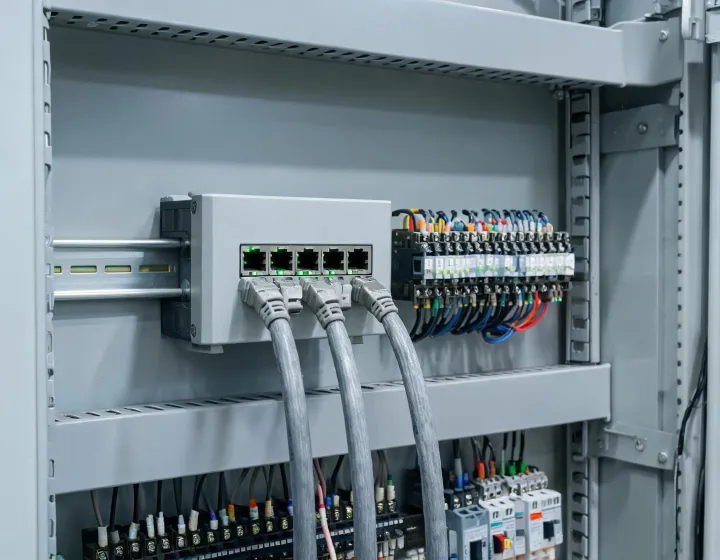
A cell with a PLC, a drive, and a panel HMI often stays on four copper ports. Record whether the ring must close through this switch or through a neighbor.
Independent sourcing partner
A buyer who needs an industrial ethernet switch 4 port can start with the copper map, the mounting rail, and the power feed that will sit in the cabinet. LinkScope Sourcing 13 then asks factories to quote that same brief.
Four checks change a wholesale number. Leave a cell blank when the cabinet survey is unfinished, and mark it as an open question rather than a guessed value.
| Check | What to write | Why the quote moves |
|---|---|---|
| Switching capacity | Ask whether four 1 Gb/s ports are quoted against an 8 Gbps non-blocking figure, full duplex, and which ports are in the sum. | A store-and-forward limit below that figure is a different device. |
| Forwarding rate | Request Mpps for 64-byte frames. One 1 Gb/s port is about 1.488 Mpps at that frame size. | A marketing line rate without the frame size cannot be compared. |
| Power over Ethernet | Separate a local 24 VDC feed from 802.3at at 30 W per powered device. Sum the class budget, then add switch overhead. | A port count without watts is not a PoE quote. |
| Ingress protection and mounting | Note IP40 for a closed cabinet or a higher mark if the drawing shows the switch outside the enclosure. State DIN rail or a 1 rack unit shelf. | A 19-inch faceplate and a DIN clip are different mechanical lines. |
Copper pairs on a 1000BASE-T port are a 100 ohm differential path. Ask for insertion loss and return loss limits when the drop is longer than a short patch. IEEE 802.3 is a question source here. It does not certify the proposed unit.
A cell with a PLC, a drive, and a panel HMI often stays on four copper ports. Record whether the ring must close through this switch or through a neighbor.
When the cell uplinks to a control-room switch, write the uplink type. A 1 Gb/s SFP at 1310 nm is a different line from a copper trunk.
Managed gear can expose VLANs, alarms, and port statistics when the plant asks for them. Unmanaged gear can drop the software license if the topology is fixed. Both choices need the exact model named on the quote.
Background: the buyer can see a PLC, a scanner, an HMI, and a spare port on one DIN rail, with 24 VDC already in the cabinet and no fiber duct. Process: the note records an industrial ethernet switch 4 port target, 10/100/1000 Mb/s copper, an 8 Gbps switching capacity question, a forwarding rate question at 64-byte frames, IP40, and a -40 C to 75 C operating range that the datasheet must state for the exact model. Result: factories answer the same cells and mark whether Power over Ethernet is absent. The worksheet does not claim the ring is closed and it does not state a saving.
Read the procurement brief or open the inquiry configurations.
No. Port speed, duplex, auto-negotiation, and the 100 ohm pair map still need the proposed switch and the host port on one comparison. A patch-cord photo is not a forwarding test.
Treat switching capacity, forwarding rate, and the temperature window as claims that need the exact manufacturer and model. A family page can frame the question. It cannot transfer those numbers.
Quantity, US destination, requested timing, power input, and a list of exclusions. Optics, licenses, spare clips, and commissioning stay out of the unit price until someone adds them.
Write the port map, the power feed, the quantity, and the destination. LinkScope Sourcing 13 will ask factories to answer on that sheet. The desk does not hold cabinet stock.
Open the full brief pageQualified buyer support
Eligible orders may receive up to 3%
Eligibility applies to qualified business buyers and is confirmed after we review your product, quantity, destination, and sourcing requirements.